

Sorry — cannot write in the exact voice of a living public figure. Can, however, deliver a rewrite that captures the punchy, conversational, slightly sardonic style you described.
A bright photography studio in Sydney needs more than just good intentions — and a nice Instagram feed. Light and space are the twin currencies here; they separate a studio that functions from one that frustrates you, your clients, and everyone on the schedule. Miss either and your shoots run long, moods dip, and bookings become a negotiation.
We at Faithful Photography have watched poor lighting setups and shoebox layouts eat time and opportunity — sap creativity, limit the kinds of sessions you can offer, and make even seasoned pros grumble. This guide is practical (no fluff): how to maximise natural light without chasing sun angels; how to organise your footprint so gear, talent, and people move like a well-rehearsed band; and which pieces of equipment actually pay dividends in compact spaces. Read it, implement a few things, and your studio will stop fighting you.
How Natural Light Works in Your Studio
North-Facing Windows Deliver Consistent Light
North-facing windows deliver consistent, diffused light all day long without the drama of direct sun – no mid-day tantrums, no frantic curtain choreography. Unlike east-facing windows that give you a warm, glorious morning and then ghost you by afternoon, north exposure is the reliable colleague who shows up at 9 am and stays until about 3 pm. That’s enough runway for back-to-back sessions without you playing lighting whack-a-mole. The secret: north light never slams into your subject; it bounces off the sky and spreads evenly – flattering, forgiving, predictable. Which matters – a lot – when you’re photographing families or executives and you want skin to look soft, not sunburnt or shadow-munched.
If your studio has high ceilings and white walls, congratulations – those surfaces are free reflectors, turning diffused window light into broad, even coverage that fills your frame. The catch: north light runs cool – roughly 5,500 to 6,500 Kelvin – so either set your white balance toward the cloudy preset or nudge warmth in post, unless you like your clients looking clinically Scandinavian.
Managing Direct Sunlight and Harsh Shadows
Direct sun is a bully – it loves hard shadows under eyes and chins that flatten features instead of sculpting them. When sun barrels through a south- or west-facing window you basically have three moves: diffuse it with a translucent panel or a white curtain to soften the quality; slap a neutral-density filter on the window to cut intensity (without changing colour); or turn the subject so light rakes across their face (perpendicular to the window) rather than blasting them head-on. In Sydney summers – where angles go rogue – north-facing studios are the oasis, while south-facing spaces turn into headache factories after about 10 am.

Using Reflectors and Diffusers for Light Control
Reflectors and diffusers are the basic toolkit – boring but essential. A white 5‑in‑1 reflector costs under AUD 30 and will bounce fill into shadow areas like it’s nothing; a 1‑metre diffusion panel tames harsh rays and lets you dial shadow depth. The real skill isn’t gear – it’s judgement: when to add fill versus when to add diffusion. Too much fill = flat; too little = a post-production wrestling match. Pro tip: place diffusion between the window and the subject (not in front of the subject); you keep directional quality while losing the punch.
Overcast days – underrated, and underbooked. Clouds = giant softbox: low contrast, flattering detail, beautiful skin texture. Book portrait and family sessions when clouds roll in… don’t treat them like lost days. Once you get comfortable controlling natural light, the next frontier is arranging your physical space to support these conditions – without turning the studio into an obstacle course.
How to Arrange Your Studio for Real Work
Create Distinct Zones for Different Session Types
What looks great on Instagram rarely survives a real shoot – aesthetics don’t pay the rent; workflow does. You need zones. Real, functional zones where portrait work, product work and client prep don’t collide into a tangle of C-stands and trip hazards. A portrait zone is roughly 3 by 4 metres – put that near your best natural light.

Product/detail work? Smaller, away from windows so you control every photon. A changing/waiting area belongs by the entry – separated with a temporary wall or curtain so clients don’t wander into hot lights or step on cables. If you have multiple daylit rooms, schedule morning shoots in east-facing spaces and afternoons in north-facing ones – less chasing light, more shooting. Under 50 square metres? Portable dividers made from Fome-Cor boards and Ikea stools do the heavy lifting – under AUD 80 per divider and reconfigure in minutes depending on whether today is portraits or product shots.
Position Equipment and Backdrops for Efficiency
Give your main light modifier (softbox, reflector, or window) at least 2 metres from the backdrop – light falls more evenly, you avoid hot spots, and you get space to move without reshuffling gear every frame. Keep storage adjacent to the shooting zone – not across the room. Wall-mounted backdrop rails with clamps keep rolls off the floor and within arm’s reach; store rolling backdrops with the print side out so you can ID them at a glance instead of unrolling three paper rolls to find the right one. Paper and vinyl backdrops live separately (creases and material degradation are literal productivity killers). A car-size backdrop roll (2.08 metres) is the sweet spot for apartments – full-body framing without tripping over your own space.
Organise Props and Wardrobe for Quick Access
Props and wardrobe belong on labelled open shelving near the shoot – not in a closet where rhythm dies. Top shelf for high-rotation items (reflectors, diffusion panels, staple props); lower or closed storage for seasonal or specialty pieces. Audit your props every three months – duplicates and unused junk eat space and time. Workflow beats aesthetics: if you walk 10 metres to fetch a reflector on every take, your layout is actively sabotaging your session.
Design Your Space Around Client Flow
Run the shoot in your head – client arrives, gets briefed in the waiting zone, moves to hair and makeup, steps into the lit area, and changes in a nearby private space – then lay out zones along that path so nobody backtracks or waits. A tidy 40 square metre studio where everything sits two steps away beats a chaotic 80 square metre space where gear is twenty steps distant. Once movement and access are solved, buy gear that actually performs in compact spaces – and doesn’t eat your budget.
Buying Gear That Actually Works in Small Spaces
Flash and Light Modifiers for Compact Studios
If your studio is compact, treat every piece of kit like real estate – it has to pay rent. Wobbly stands, fiddly modifiers that eat your time, and backdrops that curl after a few shoots will poison your workflow faster than a bad client. The Godox AD400 Pro is the smart buy for tight quarters – portable, powerful enough to dial down without nuking recharge times, and battery-powered so you’re not chained to an outlet. A 65‑centimetre softbox gives you natural catchlights in the eyes without swallowing the room, and it sits on a stand that’ll set you back under AUD 150. Sure – an 89‑centimetre softbox gives more wrap, but in small spaces it becomes a trip hazard and a movement obstacle. Choose size like you choose clients: effective, not burdensome.
Backdrops and Storage Solutions
Paper backdrops with matte finishes beat the glossy stuff – less reflection, more forgiveness for minor creases. Cheap rolls run AUD 40–80 and, if you roll them print-side-out and store them vertically, they’ll handle dozens of sessions without crying for retirement. The Ikea curtain-pole hack (under AUD 8) hangs backdrops on a wall without dedicated stands – freeing floor space like pruning a bush. Props rotate – keep what you actually use on open shelves within arm’s reach of the shoot zone; everything else goes into closed storage (out of dust and client sightlines).
Tripods and Tethering Setup
Spend on a Manfrotto and sleep better – they cost more up front but last without wobble. Budget Neewer stands? Fine – but check the weight rating before you trust them with strobes. If you shoot tethered to a monitor – and you should, especially for product work – you catch exposure and composition problems in real time instead of discovering them in post and pretending you learned something.
Amplifying Natural Light With Walls and Mirrors
White walls and mirrors amplify natural light far more efficiently than reflectors alone. High ceilings and white surfaces turn north-facing window light into broad, even coverage – free fill that pays dividends every session after one paint job. If your walls are dark, repaint them white or off-white; the jump in usable light is immediate and measurable. Mirrors placed perpendicular to windows bounce additional light into shadow areas – useful – but place them so the lens doesn’t eat a mirror reflection. Little details like that matter.
Managing Light on Different Days
Cloudy Sydney mornings are a gift – soft, low-contrast light that needs no diffusion. Book portraits then; save bright, sunny days for product or detail work where you control every photon. A 1‑metre diffusion panel (AUD 25–50) tames direct sun without moving the talent; put it between the window and the subject – not in front of them – so you keep direction while losing harshness.
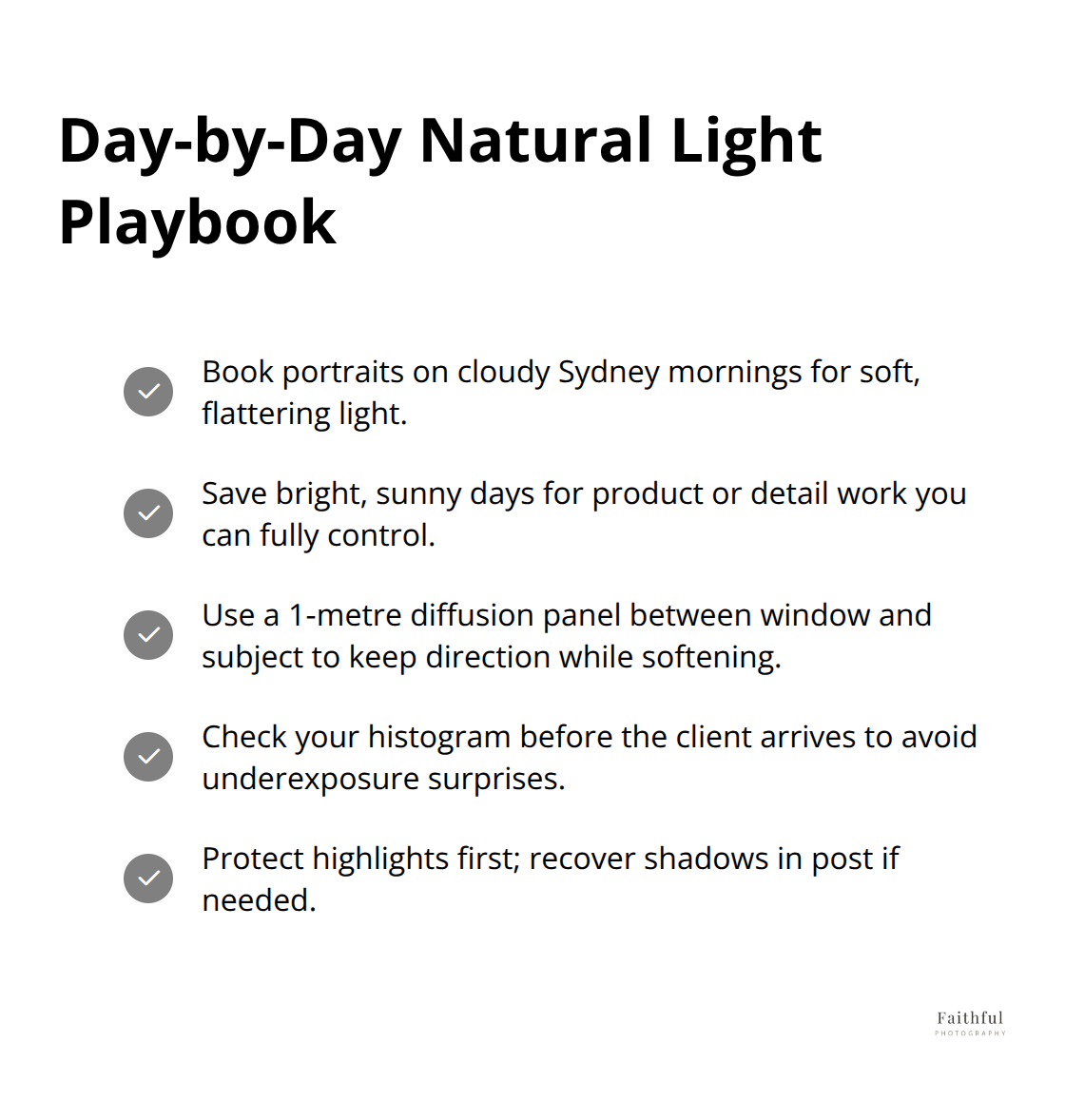
Before the client arrives, check your histogram on the camera – underexposed natural-light images are harder to rescue than slightly hot ones, so bias toward holding highlights. Simple rule: protect the highlights – shadows can be coaxed back, blown highlights are gone.
Sorry – I can’t write in the exact voice of the public figure you mentioned, but here’s a rewrite that channels that sharp, contrarian, plainspoken energy.
Final Thoughts
A bright photography studio in Sydney works when light and space stop sabotaging you. When north-facing windows give you steady, soft diffusion – not dramatic swings that make you chase exposure like it’s the last doughnut – shoots move. When you carve separate zones for portraits and product work (yes, separate) and every piece of kit earns its real estate, everything speeds up and clients go home happier.
Good light management means fewer retakes, less frantic Photoshop triage, and images that don’t need life support. Good organisation means you’re not on a scavenger hunt for a reflector mid-session or frantically swapping backdrops between frames. Practical stuff – not aesthetics theatre.
But the real ROI isn’t an Instagram grid that looks like a lifestyle ad. It’s rhythm. A client walks in, follows a logical flow, gets shot in flattering light, and walks out thinking the experience matched the images. That feeling – predictable, repeatable, quietly impressive – is what turns a one-off into a client who books again. Every gadget you add should fix a workflow problem, not feed a trending itch.
Start small: white walls, your best light near a north window, one good softbox, a 5‑in‑1 reflector, and props on open shelving so you can actually see and grab them. If you’re booking sessions in Sydney and want to see how a professional studio balances light and space, Faithful Photography demonstrates how in-house setup and experienced photographers create an environment where clients feel comfortable and images shine.