

Key Takeaways
- Safety and comfort are the foundation of every great newborn pose — a settled, supported baby produces the most dreamy images.
- Newborn bodies are not tiny adults; understanding head weight, spinal flexibility and temperature control is non-negotiable before any session begins.
- Composite techniques — including the iconic froggy pose — deliver the aesthetic you love without placing your baby at risk.
Why Newborn Posing Is a Discipline of Its Own
There is a temptation to treat newborn photography as a smaller, cuter version of any other portrait session. It isn't. Newborn posing is its own discipline — one that demands patience, warmth, a steady pair of hands and a genuine willingness to let the baby lead every single moment of the shoot.
Older children and adults give you visual cues. They shift, blink, smile on request. Newborns offer none of that. They communicate through body language alone, and misreading those signals has real consequences. At Faithful Photography — with studios in Glen Alpine and Gledswood Hills serving families across Campbelltown, Camden, Narellan and the broader Macarthur region — our approach rests on one principle: the safest poses make the best pictures. Full stop.
This guide walks through how newborn bodies actually work, which gentle poses consistently deliver gorgeous results, and how to keep every session calm, comfortable and completely stress-free. Whether you're a first-time parent researching what to expect or simply curious about our process, read on.
Understanding Newborn Bodies — The Structural Basics
Head Weight and the Neck
A newborn's head accounts for roughly 25 per cent of total body weight. In adults, that figure sits closer to 10 per cent. This single anatomical fact underpins every safe posing decision you'll ever make during a newborn photography session in Sydney.
The neck muscles simply haven't developed the strength to support that disproportionate load. Every pose must treat head and neck support as the primary constraint — aesthetics are always secondary. Always.
The Spine Is Largely Cartilage
A newborn's spine is mostly cartilage rather than hardened bone, which gives babies their extraordinary flexibility. You'll see them curl into shapes that look completely effortless. But flexibility is not the same as strength, and this distinction matters enormously when you're positioning a baby for a pose.
A position that looks serene in a photograph can quietly pinch an airway or hyper-flex a neck if the chin drops inward. Treat every pose as a support-first problem. The aesthetic is a secondary consideration — always evaluate it that way.
Temperature Control — The Often-Overlooked Variable
Newborns cannot regulate their own body temperature. They lose heat rapidly, and when they're cold they're tense. Tense muscles mean fighting every position and a very unsettled baby. The opposite is equally true: a comfortably warm environment encourages deep, settled sleep that makes posing feel almost effortless.
In our Glen Alpine studio and our Gledswood Hills studio, we maintain a warm ambient temperature throughout every newborn session. It isn't a luxury — it's the single greatest practical tool for producing relaxed expressions and holding poses for longer.
- Keep the space at a comfortable, warm temperature — warm enough that the baby doesn't need heavy wrapping unless it's part of the aesthetic setup.
- Position a heat lamp or space heater near the beanbag when the baby is unwrapped.
- Avoid direct airflow from air conditioning or fans aimed at the baby.
- Warm any props, wraps or fabric before placing the baby against them.
The payoff is immediate. A warm, settled newborn stays put longer, repositions with minimal fuss and gives you far more genuine shooting time per pose. Less scrambling. Better images. Simple optimisation.
Reading Your Baby's Signals — The Language Every Photographer Learns
Newborns communicate entirely through their bodies. Learning to read that language is what separates a calm, confident session from a stressful one — and it's what keeps every moment safe for the baby in your care.
Signals That Mean Stop Immediately
- Gasping, grunting or laboured breathing — remove the pose in seconds, not minutes.
- Sudden colour changes, especially darkening or blueing around the lips or face.
- Rigid body stiffening or tight, clenched limbs — these are distress signals, not quirks.
- Hard arching of the back or sustained fighting against a position — this is pain, not personality.
If a baby's airway may be compromised, you move immediately. Parents often freeze in those moments; the photographer cannot afford to. Act first, reassure after.
Signals That Are Manageable
- Mild fussiness — usually resolved with a feed, a nappy change or a settle in a parent's arms.
- Shaky or jerky movements — often cold or mildly overstimulated; warm the environment and wait a few minutes.
- Light mottling, that faint marbled skin pattern — typically a temperature response; warm the baby and monitor closely.
Healthy skin tone during a session should be pink and even. Persistent pallor, flushing or mottling are stress indicators. Read them and respond. The photographs can always wait; the baby's comfort cannot.
Gentle Poses That Consistently Deliver Dreamy Results
At Faithful Photography, we work with a core set of safe, gentle poses proven to deliver beautiful results for babies in their first two weeks of life. Knowing exactly which positions are structurally sound means we can focus entirely on the light, the expressions and the extraordinary tiny details that make newborn portraits so precious.
Our go-to pose repertoire includes:
- The taco / potato pose — baby curled gently on their side or front in a beanbag, mimicking the foetal position they've known for months. Naturally comfortable, requires minimal repositioning and captures that iconic peaceful newborn look beautifully.
- Side-lying poses — full head and body support with the baby on their side. These produce gorgeous profile shots and allow beautiful wrapping compositions with very low structural risk.
- Back-lying poses — baby resting on their back in a basket, wrap or on a softly textured surface. Versatile, safe and perfect for overhead angles that highlight tiny hands, feet and facial features.
- Parent-hold poses — a parent's hands cradling an impossibly small body. Inherently safe, deeply emotional and some of the most genuinely moving images from any session. These translate naturally into family photoshoots in Sydney where the whole family dynamic is captured together.
- Wrapped poses — a snug, secure wrap mimics the womb environment, settles unsettled babies quickly and creates a clean, minimal aesthetic that focuses the eye entirely on the baby's face.
None of these poses require force, contortion or clever-sounding risk-taking. They work because they respect how newborn bodies are actually built.
The Froggy Pose — Beautiful Results Through Safe Compositing
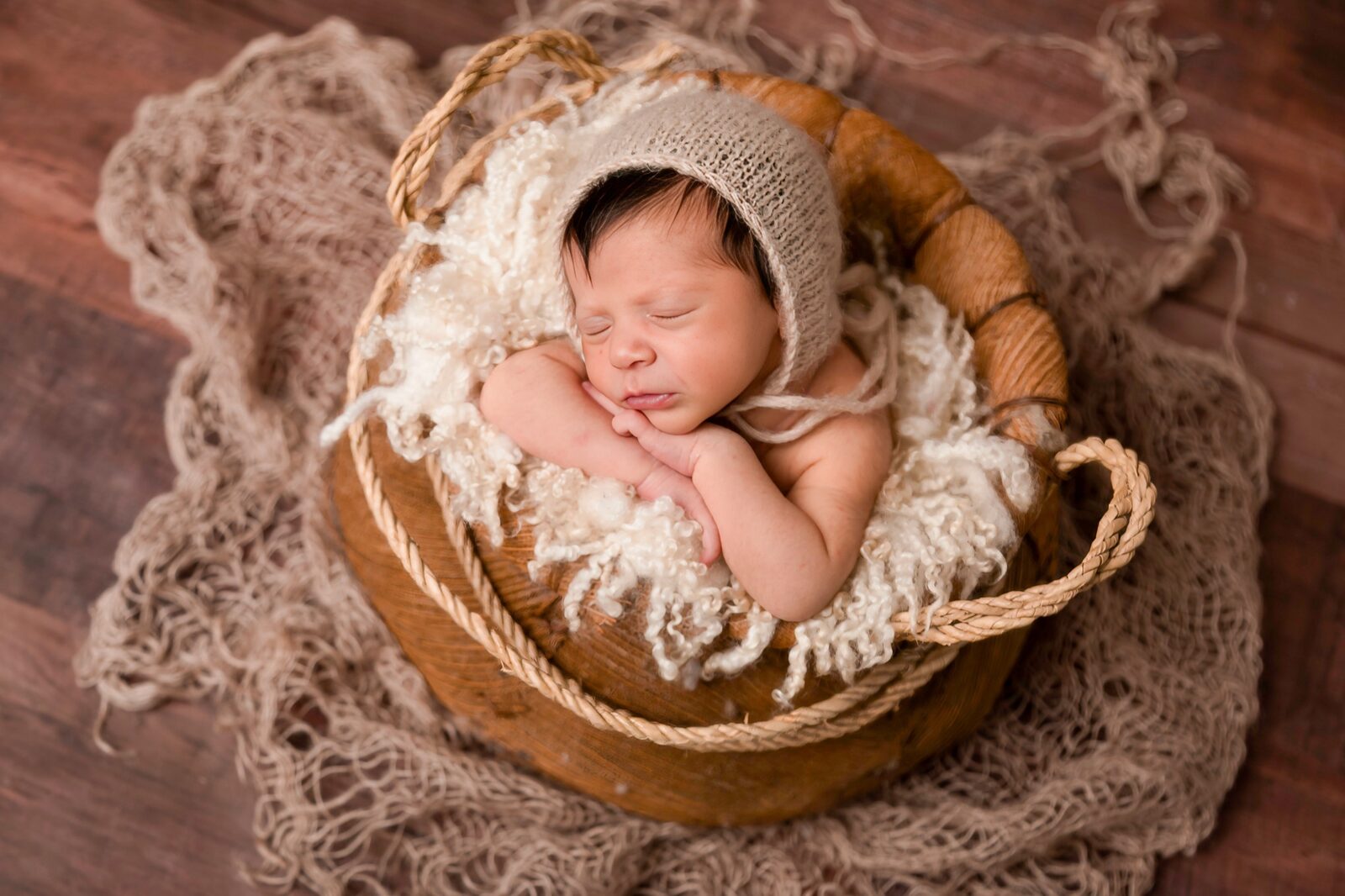
No pose generates more requests — or more well-intentioned but genuinely dangerous attempts — than the froggy pose. Tiny body curled like origami, chin resting on miniature hands: it stops scrolls, it stops conversations and it's been the most-pinned newborn image on the internet for over a decade.
The problem is structural. A newborn's arms cannot support their disproportionately heavy head. Attempting a single-frame froggy without composite technique places real pressure on a baby's neck and potentially on their airway. The risk isn't hypothetical — it's basic physics.
"The safest poses make the best pictures. Skipping composite technique on the froggy pose isn't bravery — it's recklessness dressed up as artistry."
The safe version uses newborn compositing: photograph the baby in a fully supported curl on a beanbag, capture a separate frame with the hands gently positioned by the photographer, then merge the two in post-production. The final image looks identical to the risky single-frame version. The baby never bears unsupported weight. The result is every bit as dreamy — achieved with skill rather than luck.
This principle scales readily. The cocoon pose, the head-on-hands setup and any position where small limbs appear to support weight all benefit from compositing. The aesthetic never suffers. The safety always wins.
Structuring Your Newborn Session for Safety and Success
Ready to capture your newborn's first days?
Our gentle, unhurried sessions are designed entirely around your baby's comfort — so every image feels effortless, authentic and timeless.
Timing and the Right Age Window
Plan for a two-to-four-hour session. Not because posing takes that long — it doesn't — but because feeding, nappy changes, settling and the unexpected all eat into the clock. Rushing a newborn through setups is exactly how mistakes happen.
The ideal age window for newborn posing is within the first ten to fourteen days of life. Babies in this period sleep deeply, curl naturally into the foetal position and remain relaxed enough for gentle poses. After two weeks, the startle reflex strengthens and sleep becomes lighter — both make posing noticeably more challenging. We recommend booking during pregnancy so we can hold a date close to your due date.
Stay Within Arm's Reach
Remain within arm's reach throughout the entire session. When repositioning the baby or adjusting props, keep one hand available to support the head and neck instantly. A parent or assistant can spot, but you are the primary safety contact. If something feels off, stop. Your instinct in those moments is more reliable than any protocol.
Choosing the Right Photographer
Newborn posing is not a skill learned on the fly. When researching photographers in Campbelltown or Camden photographers for your newborn session, ask directly about their training in safe newborn handling and composite technique. A qualified photographer will welcome the question. Your baby's wellbeing is worth having that conversation.
Preparing for Your Session — A Parent's Practical Guide
You don't need to arrive as an expert in newborn posing. You just need to arrive prepared. Here's how to give your session the very best possible start:
- Feed your baby just before you leave home — a full, drowsy baby is infinitely more cooperative than a hungry one.
- Dress your baby in a loose, front-opening outfit — less fuss undressing means a calmer, quicker start to the session.
- Bring extra formula or plan to breastfeed during the session — at least one feed mid-session is normal and expected.
- Don't stress about timing — we build flexibility into every booking; your baby's natural rhythm is our rhythm.
- Discuss your vision beforehand — whether you love minimal, organic setups or lush, layered props, let us know in advance so we can prepare accordingly.
If you're planning ahead, consider pairing your newborn session with maternity photography in Sydney for a complete visual journey from bump to baby. Many families across the Macarthur region book both together, and the storytelling across the two sessions creates something genuinely irreplaceable.
Frequently Asked Questions
What is the best age for a newborn session in Sydney?
The ideal window is within the first seven to fourteen days after birth. Babies in this period sleep deeply, curl naturally into the foetal position and remain flexible enough for gentle curled poses. After two weeks, the startle reflex strengthens, sleep becomes lighter and settling takes longer. We recommend booking during pregnancy so we can hold a date close to your due date and confirm the booking once your baby arrives.
Is the froggy pose safe for newborns?
It can be — but only when executed using proper composite technique. A newborn's arms cannot safely support the weight of their head in the classic froggy position. Responsible photographers capture two separate, fully supported frames and merge them in post-production. The final image looks identical to the risky single-frame version, and the baby is never placed under structural stress. Always ask your photographer whether they use compositing for this pose before your session.
How long does a newborn photography session take?
Most newborn sessions at Faithful Photography run for two to four hours. The additional time accounts for feeds, nappy changes, settling periods and the unhurried pace that safe posing requires. We never rush — the session follows your baby's lead, not a clock. Arriving relaxed and having fed your baby just beforehand gives every session the best possible start.
What should I do if my baby is unsettled during the session?
Unsettled babies are completely normal — we plan for them. A feed, a nappy change, a warm cuddle or simply pausing for five minutes is usually enough to bring a baby back to a calm state. If your baby shows signs of genuine distress — rigid body, colour changes, laboured breathing — the session pauses immediately and we attend to your baby first. The photographs are never more important than your baby's comfort and safety.
Do you offer newborn sessions for families across the Macarthur region?
Absolutely. Faithful Photography operates studios in Glen Alpine and Gledswood Hills, conveniently located for families across Campbelltown, Camden, Narellan, Harrington Park, Gregory Hills, Mount Annan and the wider South-West Sydney region. View our full range of options on our newborn photography Sydney page, or check our session pricing for current inclusions and packages.
Can siblings or grandparents be included in the newborn session?
Yes — and some of the most treasured images from any newborn session are the sibling moments. We can include siblings and parents in select setups as a natural part of your booking. For larger family groups wanting to celebrate the new arrival together, ask us about our extended family sessions, which are designed to capture multiple generations beautifully and comfortably.
Visit Faithful Photography Today
Your newborn's first days are fleeting — let us preserve them with safe, gentle, beautifully crafted portraits you'll treasure for a lifetime. Serving families in Glen Alpine, Gledswood Hills, Campbelltown, Camden, Narellan and across South-West Sydney's Macarthur region.