Key Takeaways
- A professionally designed newborn photography studio controls temperature, lighting and sound to keep babies calm, settled and sleeping deeply throughout the session.
- Every prop, pose and piece of equipment at Faithful Photography meets strict safety standards — including composite techniques for high-risk poses so beauty never comes at the expense of safety.
- Preparation is everything: knowing what to expect, how to feed and settle your baby beforehand, and choosing a studio purpose-built for newborns makes all the difference to your final gallery.
Why Studio Design Is the Foundation of Great Newborn Photography
Most parents arrive at their first newborn session with a beautiful, exhausted baby and absolutely no idea what happens next. That uncertainty is completely normal — and the studio's job is to absorb it. A properly designed newborn photography studio in Sydney does far more than provide a backdrop. It creates a micro-environment that mimics the conditions a baby has known for nine months: warmth, gentle sound, dim and diffused light, and the sensation of being securely held. When those conditions are right, babies settle faster, sleep deeper, and stay asleep longer. The result is a relaxed session, a relaxed family, and a gallery full of images that genuinely reflect those fragile, fleeting first days. ### The Difference Between a Studio and a Home Setup- Consistent temperature control — a home heater warms unevenly; a studio with dedicated heating maintains a precise, stable environment from the first pose to the last.
- Professional lighting — window light shifts with cloud cover and time of day; calibrated studio lights deliver the same creamy, soft exposure across an entire session.
- Purpose-built safety protocols — professional studios carry public liability insurance, trained staff and accredited posing techniques that simply aren't replicable at home.
- Dedicated settling space — feeding nooks, change areas and quiet rooms mean parents and babies can reset privately without disrupting the shoot.
Temperature and Lighting: The Two Non-Negotiables
### Warmth That Keeps Newborns Settled Newborns are notoriously poor at regulating their own body temperature, especially in those first two weeks. The moment a baby is undressed in a cool environment, their nervous system kicks in, and that's the end of calm. Stress responses — wriggling, crying, a rigid body — make posing impossible and distressing for everyone. Our studios are maintained at around 23–24°C throughout every session. We use strategically placed heaters to eliminate cold spots, and one of our team monitors the ambient temperature continuously. "Close enough" simply isn't good enough when a settled newborn is the goal. The warmth also serves a physiological purpose: babies sleep faster in a warm environment. If your little one drifts off in the car on the way to the studio, a consistently warm room preserves that drowsy state rather than jolting them back to full alert. ### Soft, Diffused Light — Never Direct Flash Professional lighting in newborn photography isn't about brightness; it's about quality and control. We use continuous studio lights fitted with large softboxes and diffusers that wrap light around a baby gently — no harsh shadows, no startling bursts of white. Natural window light is beautiful, but it is entirely unreliable. Clouds shift, the sun arcs across the sky, and your gallery can end up looking inconsistent even within a single session. Studio lighting recreates the same conditions for every single pose, delivering that soft, even, timeless aesthetic parents expect in fine-art newborn portraiture. Direct flash is never used. The sensitive retinas of newborns and the startle reflex triggered by sudden light bursts make flash wholly inappropriate. Diffused, constant light is the only responsible choice.Props and Safety Standards We Never Compromise
Walk into any quality newborn photography studio in Sydney and you'll notice the props aren't there for decoration — they're tools. And like all tools, they need to meet exacting safety standards before they come anywhere near a baby. ### What Makes a Prop Safe? At Faithful Photography, every prop that touches a newborn has been assessed against a strict checklist:- No sharp edges, protruding hardware or loose small parts that could be swallowed
- Structurally sound — baskets, bowls and crates are load-tested to support infant weight without flexing
- Hypoallergenic, baby-safe fabrics and dyes that won't irritate delicate skin
- Appropriate sizing — a prop that's too large makes a baby look lost; one that's too small creates unsafe compression
- Cleaned and sanitised between every session
"The most beautiful newborn images are never the result of risk — they're the result of rigorous preparation, skilled hands, and a studio environment designed entirely around the baby's wellbeing."
Settling Techniques That Actually Work
### White Noise and the Womb Effect Silence is not a baby's natural environment. For nine months, your newborn listened to the constant rush of blood flow, the rhythmic thud of your heartbeat, and the muffled backdrop of your voice. Quiet is foreign — and for many newborns, unsettling. White noise is one of the most effective settling tools in professional newborn photography. Played at a consistent volume, it drowns out studio interruptions — the soft click of a shutter, footsteps, a door closing — and activates the calming reflex that mimics intrauterine sound. Babies relax faster and nap longer. We use a combination of white noise machines and gentle instrumental music at low volume. The white noise handles the startle reflex; soft music layers warmth into the room's atmosphere. Neither replaces the other. ### Swaddling, Positioning and Gentle Movement A secure swaddle provides the physical containment that newborns instinctively crave. It reduces the Moro reflex — that involuntary full-body startle that wakes babies just as they drift off — and signals to a baby's nervous system that it's safe to let go. Between poses, gentle rhythmic movement — a slow, shallow bounce or a soft side-to-side rock — can reset a stirring baby without fully waking them. Our team is trained in these calming techniques, and they're used constantly throughout a session.What to Expect During Your Session at Faithful Photography
A typical newborn session in Sydney at Faithful Photography runs for two to four hours. That time frame can surprise first-time parents, but it's deliberate. We never rush. Here's how a session generally unfolds:- Arrival and warm-up — the studio is already at temperature. Parents settle in, the baby is checked, and we discuss the session plan, props and colour palette.
- Feeding and settling — we encourage a feed before posing begins. A full, warm baby settles far more readily than a hungry one.
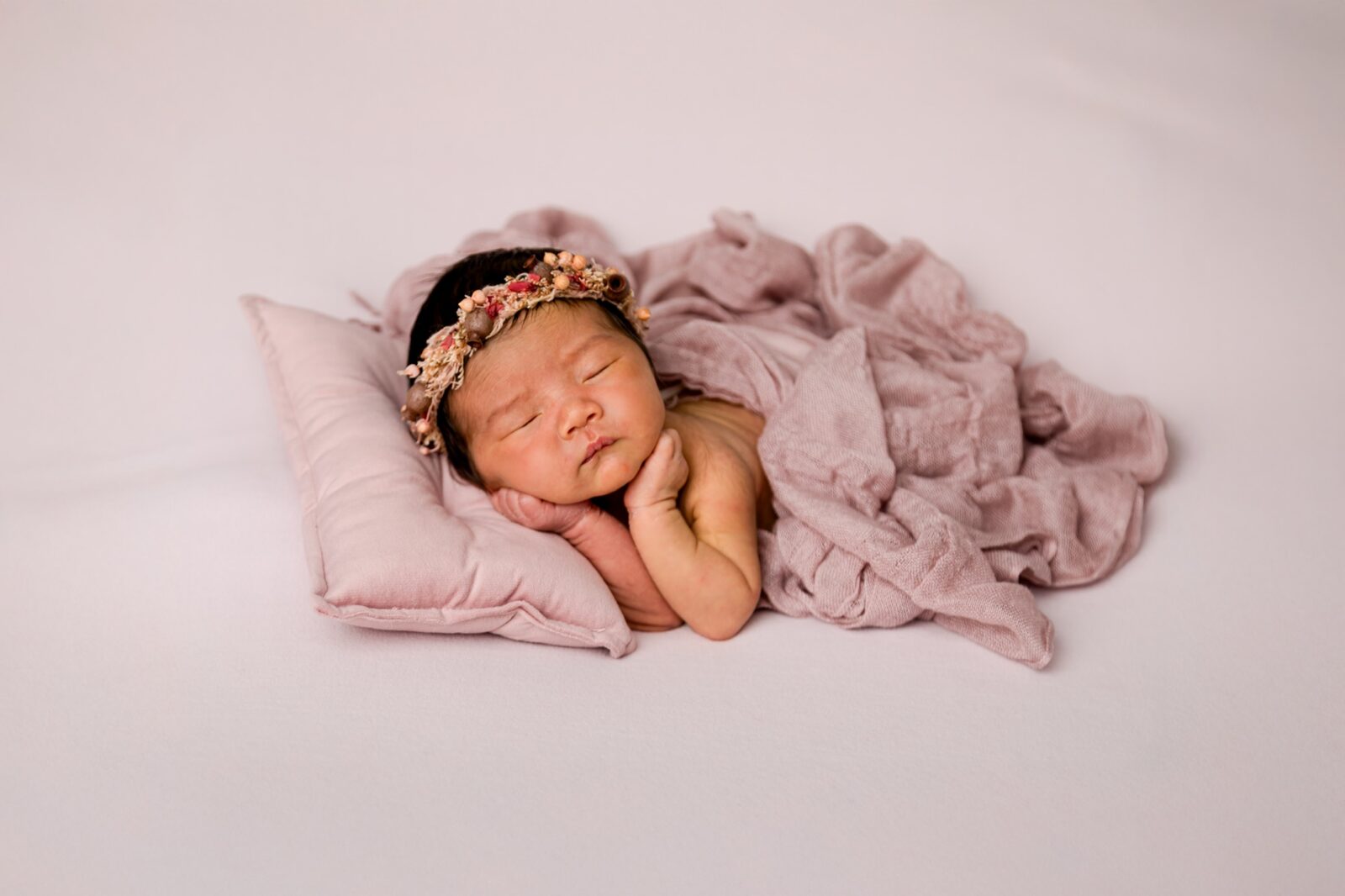
- Posed newborn work — with the baby in deep sleep, we move through our planned poses, using white noise, swaddling and gentle positioning techniques throughout.
- Parent and sibling inclusions — once posed solo shots are complete, we bring in family members for connection shots. These are some of the most emotional and treasured images from any session.
- Wrap-up — the baby is redressed, parents receive a brief overview of the gallery delivery timeline, and we farewell you with a very well-photographed little person.
Ready to Book Your Newborn Session?
Spaces fill fast in the first trimester — secure your newborn session before your due date and we'll hold your spot with a flexible reschedule guarantee.
How to Prepare for the Best Possible Newborn Session
The studio does most of the heavy lifting — but there are a handful of things parents can do beforehand to set the session up for success. ### Feed Right Before You Leave Home Timing a feed so your baby finishes 20–30 minutes before arriving at the studio is ideal. A fully fed baby in a warm car will often arrive already drowsy, and the studio's warm environment helps preserve that state. ### Keep Clothing Simple on the Day- Dress your baby in a loose onesie or stretchy wrap — nothing with tight elastics that leave marks on skin
- Avoid mittens or booties that might leave indentations around wrists or ankles
- Bring a spare outfit and extra nappies — accidents are part of every newborn session, and we are entirely unbothered by them
Beyond Newborns: Our Full Studio Experience
Faithful Photography is more than a newborn photography studio in Sydney. We offer a full suite of professional portrait services, all delivered with the same obsessive attention to environment, safety and preparation.- Family photoshoots in Sydney — from intimate couple sessions to large extended family portraits, we create relaxed, natural galleries that reflect who your family actually is.
- Cake smash photography in Sydney — a joyful, playful milestone session for your baby's first birthday. If you're curious about studio setups for cake smashes, read our guide to Cake Smash Studio Setup: Designing Sweetly Memorable Moments.
- Maternity photography in Sydney — honouring the glow and power of pregnancy with soft, artful portraiture. See our Maternity Portrait Session Ideas for inspiration.
- Corporate photography in Sydney — polished professional headshots and team portraits for businesses across the Macarthur region and Greater Sydney.
Frequently Asked Questions
When is the best time to book a newborn photography session?
Ideally, book during your second trimester — between 20 and 30 weeks pregnant. Newborn sessions are best conducted in the first 5–14 days of life, when babies are sleepiest and most flexible. We hold your booking with an estimated due date and confirm the exact session time once your baby arrives. Spaces fill well in advance, so early booking is strongly recommended.
How long does a newborn photography session take?
Plan for two to four hours. We never rush a newborn session — the time is built around your baby's needs, not a clock. Feeding breaks, nappy changes, settling time and reset periods between poses are all factored in. The result is a relaxed experience for parents and a deeply settled baby for the photographer.
Is newborn photography safe for premature or very small babies?
We assess each baby individually in consultation with parents. For premature or medically complex babies, we may recommend delaying the session until the baby is more robust, or modifying our posing to suit their specific needs. Your baby's wellbeing is always the priority, and we will never proceed with any pose or prop we are not fully confident is safe for that individual child.
Can siblings and parents be included in the session?
Absolutely — and we encourage it. Sibling and parent inclusion shots are some of the most treasured images from any newborn session. We typically complete the solo newborn posed work first while the baby is in deepest sleep, then bring in family members for connection images. If you have a large family, ask us about our extended family sessions as a complement to your newborn shoot.
Where are your newborn photography studios located?
We operate from two studios in South-West Sydney — Glen Alpine and Gledswood Hills, NSW. Both locations are easily accessible from Campbelltown, Camden, Narellan, Oran Park, Gregory Hills, Harrington Park and surrounding suburbs. We are proudly local Gledswood Hills photographers and Glen Alpine photographers serving the wider Macarthur community.
What happens if my baby won't settle during the session?
It happens, and we are completely prepared for it. Our team uses a combination of white noise, gentle swaddling, rhythmic movement and warm settling techniques to coax unsettled babies back into sleep. We build extra time into every session specifically for this reason. In rare cases where a baby simply isn't cooperating on the day, we can discuss rescheduling the posed work — your investment and your gallery are always protected.
Visit Faithful Photography Today
Your baby's first days are fleeting — let our purpose-built newborn studios in South-West Sydney preserve them safely, beautifully and without compromise. Serving families across the Campbelltown, Camden, Narellan and Macarthur region from our Glen Alpine and Gledswood Hills studios.